
From Quiet to Buzzing: Rebooting Your Pub's Atmosphere on a Budget
Atmosphere is a controllable asset. Use music, lighting, scent, pacing, and host energy to make the room feel alive without ripping out the bar.
8 May 2025 · 10 min read · Peter Pitcher
Quick answer
Reset your pub's atmosphere by auditing the room as a guest at three times of day, then fixing what you find: a playlist matched to each daypart, warm layered lighting instead of harsh overheads, a scripted 30-second welcome, small daily touches like a chalkboard line, and clean, fresh-smelling toilets. Then photograph the change and post it.
Empty tables are not always a marketing problem. Plenty of pubs are getting people through the door and losing them in the first two minutes, because the room feels flat, cold, over-lit or slightly awkward to walk into.
Atmosphere gets talked about as a mood, something that happens to you. It is not. It is a set of controllable inputs: sound, light, smell, temperature, layout and the energy of whoever is behind the bar. Every one of them can be changed this week for very little money.
I run The Anchor in Stanwell Moor as a Greene King tenant, and this is the reset I run there, in order, with how to tell whether it worked.
Step 1: Run a 24-hour atmosphere audit
You cannot fix a room you have stopped seeing. Park round the corner and walk in as a stranger three times: a weekday lunchtime, a Thursday at six, a Saturday at half eight.
Each time, score these out of five, and write the score down before you talk yourself out of it:
- The approach and front door (signage lit, menu visible, does it look open?)
- The first ten seconds inside (were you acknowledged?)
- Seating choice (is it obvious where to sit?)
- Light levels and warmth
- Sound (music, or the hum of the extractor?)
- Smell, temperature, and the toilets
Take photographs at seated eye height, not from behind the bar. Photos are more honest than memory, and they show you the tired chair and the tangle of cables you stopped noticing in 2019.
Then ask three people for one thing they would change: two regulars and, crucially, one first-timer. Write your top three friction points on a single sheet and pin it in the office. Everything that follows should attack those three.
The mistake to avoid: auditing at 11am on a bright day in an empty room. That is the one moment your pub is never judged.
Step 2: Reset the soundtrack
Silence is the loudest thing in a quiet pub. Two people in an otherwise silent room hear their own conversation echo, so they leave early and drink less while they are there.
Match the music to the daypart, not to whoever is on shift:
| Daypart | Feeling you want | Volume | What works |
|---|---|---|---|
| Lunch, 12 to 3 | Calm, easy to talk over | Under the conversation | Warm, familiar, mid-tempo. No heavy beat |
| Afternoon, 3 to 6 | Comfortable, no rush | Low to medium | Soul, acoustic, older catalogue |
| Early evening, 6 to 8 | Lifting, sociable | Just above the conversation | Recognisable, upbeat, singable |
| Late, 8 till close | Energy, a reason to stay | Highest of the day, short of shouting | Crowd-pleasers, building across the night |
Three practical rules. Build each playlist at least four hours long, so nothing repeats inside a shift and your team does not start hating their own job. Take the volume control away from whoever stands nearest the speaker and give it to one named person per shift. And use the bar test: if two people ordering have to repeat themselves, drop it two notches.
One legal point people get wrong. A personal Spotify or Apple Music account does not permit commercial use, and you need TheMusicLicence from PPL PRS to play recorded music in a business at all. Use a proper business music service, keep the licence displayed, and treat both as a modest annual cost for something that changes every hour of trade.
Step 3: Light with purpose
Harsh overhead light is the fastest way to make a pub feel like a waiting room.
Get to one colour temperature. Warm white at around 2700K is the hospitality standard, close to old incandescent bulbs, and it flatters both the room and the people in it. One cool-white bulb among five warm ones ruins the effect, so walk the room at dusk and replace every mismatch. That is a bag of bulbs and an hour on a ladder.
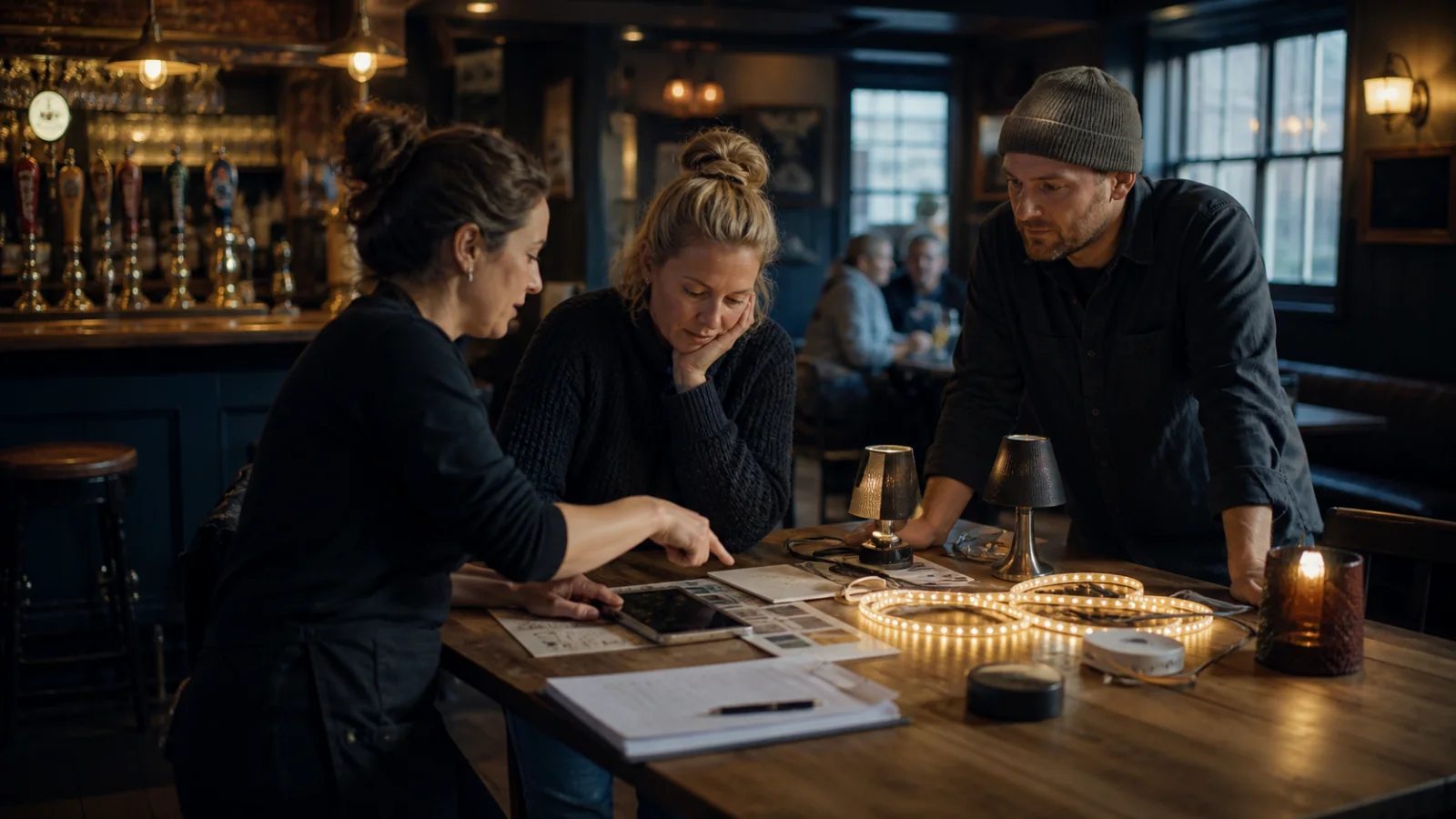
Layer it. You want a low general wash, pools of light on tables, one brighter area at the bar so it reads as the destination, and something lit outside the door after dark so the place looks open from the road. Plug-in table lamps on a cheap timer plug do most of that without an electrician.
Get dimmers where you can. Dimmable LED fittings on the main circuits let you drop the room two clicks at six o'clock, the moment a pub either becomes an evening venue or stays a canteen. If rewiring is out of reach, switch off alternate overhead circuits and lean on the lamps instead.
Two warnings. Naked flames must clear your fire risk assessment and your insurer, so battery LED tea lights in glass holders are the safer default. And never light the room evenly: that is what supermarkets do.
There is a side benefit: swapping tired halogen and fluorescent fittings for LED cuts your electricity bill too, which pairs neatly with our guide to cutting venue energy costs. The same thinking sits behind other low-cost decor refreshes: change what people perceive before you change what you own.
Make the room look occupied
This one is free and works within a shift. Shrink the room to match the trade:
- Close the far end on quiet nights. A rope, a folded screen or simply unlit lamps will do it.
- Seat early arrivals in the window and near the bar, never in the back corner. Passers-by need to see occupied tables.
- Put "reserved" cards on tables you do not want used, so nobody feels herded.
- Pull spare tables out of the room rather than leaving a sea of empties.
- Never let staff stand still behind the bar with nothing in their hands.
Then open the space back up as the room fills, so the pub appears to grow to meet demand.
Step 4: Script the host moment
The first thirty seconds decides whether someone stays, and it is entirely within your control.
Set a ten-second rule: everyone who comes through the door is acknowledged within ten seconds, even if all they get is eye contact and "be with you in a minute". People wait happily. What they will not do is stand unnoticed at an empty bar.
Give the team an actual script, four beats long:
- Greet. "Evening, come in."
- Orientate. "Food's on till nine, menus are on the tables, garden's open."
- Recommend. One thing, specifically. "The pale ale's just gone on and it's drinking beautifully."
- Name. Get theirs, use it, and use it again when they order.
Rehearse it in a fifteen-minute pre-shift with two role-plays. It feels silly for four minutes, then it becomes normal. The same muscle powers your drinks and food recommendations, which is why it pairs so well with proper upselling scripts and training.
The mistake to avoid: a team that faces the till instead of the door. Move where they stand and half the problem disappears.
Step 5: Layer micro-experiences
Small, repeatable touches give people something to notice, mention and photograph:
- A daily chalkboard line that sells the day. One thing, named, with a price, changed every day, because a stale board is worse than no board.
- One featured drink with a story behind it, not just a pump clip.
- A community board with dated posters and a monthly clear-out. Out-of-date notices signal a pub nobody is looking after.
- A jar of dog biscuits by the till, a basket of board games, newspapers that are actually today's.
- A weekly ritual at a fixed time. The fire gets lit at four on a Sunday. The quiz sheet goes out at half seven. Rituals give regulars a reason to arrive at an hour rather than "sometime".
Each costs almost nothing, and each gives your team something to talk to strangers about.
Step 6: Tidy the senses
Smell is the one thing you cannot judge yourself, because you stop noticing your own pub within ten minutes. Ask someone who does not work there.
The usual culprits: drip trays and bar mats, dry drain traps, bins near the door, a propped-open cellar door, tired mop heads, and carpets. The fixes are daily rather than dramatic. Rinse trays and mats every session, pour water down any floor gully not in regular use so the trap does not run dry, move the bin route away from the entrance, replace mop heads monthly, and machine-clean the carpets twice a year.
Do not mask a smell with a plug-in air freshener at the door. Customers read that as a cover-up and start hunting for the source.
Temperature is the other invisible killer, because a cold room reads as an empty one even when it is not. Aim for 19 to 21 degrees in the main bar, draught-proof the front door, and hang a heavy curtain in winter. Then check the toilets hourly against a signed sheet; our budget toilet refurbishment guide covers the cheap wins there.
Step 7: Capture and share
Once the room genuinely looks better, photograph it properly: lamps on, daylight almost gone, shot from the height of a seated guest, with at least one occupied table. Ask permission and photograph people rather than empty chairs, because a photo of an empty room tells people exactly what they will find.
Use the same angle every few weeks so the improvement is visible over time, and put those frames everywhere: website header, Google Business Profile, socials. If nobody outside sees the change, it is not yet working for you.
How to tell if it worked
Set a review date four weeks out and check four things against the four weeks before:
- Average transaction value on the same weekdays. A warmer, better-paced room lifts second drinks.
- Covers or till transactions by daypart, so you can see which sessions moved.
- Second-drink rate. Ask the team to note how many tables order again. It is the cleanest proxy for dwell time.
- Review language. Search your Google reviews for "atmosphere", "cosy", "welcoming" and "empty", and compare before and after.
If nothing moved, the honest answer is usually that standards slipped after week one. Atmosphere is not a project, it is an opening checklist.
Common mistakes
- Over-lighting the room. Even and bright is the enemy of warm and inviting.
- Music that clashes with the audience, or worse, silence.
- Ignoring the entrance and the toilets.
- Letting customers spread out instead of consolidating them.
- Doing it once. A single good week proves nothing to a regular.
Quick checklist
- Atmosphere audit completed at three times of day, with photos.
- Top three friction points written down and pinned up.
- Playlists built by daypart, one named person on volume, music licence displayed.
- One colour temperature throughout, lamps and dimmers in place.
- Quiet-night zoning plan agreed with the team.
- Welcome script trained and rehearsed.
- Daily chalkboard line and one weekly ritual running.
- Smells fixed at source, toilets checked hourly.
- Photos shared and a review date set for four weeks.
Mini FAQ
Do I need to buy new furniture? No. Clean, tidy, well-lit seating usually reads as new. Fix light, sound, smell and temperature first, then decide whether you still need to spend.
Who should own this day to day? One named person per shift, written on the rota, with the volume control, the lamp timers and the toilet check sheet in their hands. Atmosphere goes backwards the moment it belongs to everybody in general and nobody in particular.
questions people ask.
What's the quickest way to make an empty pub feel busy?
Does music really make a difference to pub atmosphere?
How much does it cost to improve a pub's atmosphere?
What music licence do I need to play playlists in my pub?
How long does it take to change how a pub feels?
keep reading.
- OperationsAI for Pubs: What Is New, What Works and Where to StartAI for pubs, from a working licensee: what has changed, the jobs it does well, the shortcuts worth knowing and the house rules that keep you out of trouble.24 min read
- OperationsWet-Led vs Food-Led Pubs: Understanding Your Revenue ModelWhat wet-led and food-led actually mean, the economics of each model, and how to work out which approach is right for your pub.15 min read
- OperationsFood Allergies and GDPR: The Compliance Nightmares That Could Close You DownNavigate the compliance minefield without hiring expensive consultants. Simple systems that keep you legal and let you focus on running your pub.10 min read
not sure this is your actual problem?
That's the more common situation, and it's what the first conversation is for. An hour, free, going through what's happening in your business before anybody suggests a fix.