
Harnessing Delivery and Click & Collect Without Killing Service
Layer takeaway revenue on top of pub trade without wrecking the guest experience on-site.
17 October 2025 · 10 min read · Peter Pitcher
Quick answer
Run delivery as a separate channel, not an add-on. Build a short delivery menu of dishes that travel well, cap orders per hour so the kitchen is never crushed, and set up a dispatch station with its own pick-up point. Review profit per channel weekly, and put a dine-in invitation in every bag.
Delivery is the easiest revenue in hospitality to add and the easiest to get wrong. Switch a platform on and the orders arrive, which feels like a win right up to the Friday your kitchen is twenty minutes behind, a table of eight is waiting for mains, and two riders are stood in the middle of the bar.
The answer is not to drop the channel. It is to stop treating delivery as something the kitchen does in the gaps, and start running it as a separate business with its own menu, capacity and profit line.
I run The Anchor in Stanwell Moor as a Greene King tenant, and what follows is the system I would put in place in a week, plus the arithmetic that says whether it is worth doing at all.
Choose your channel before you choose your menu
"Delivery" is four different businesses with wildly different economics. Pick deliberately.
| Channel | Roughly what it costs | What you get | Who owns the customer |
|---|---|---|---|
| Platform, their rider | Heaviest commission, commonly mid-20s to 30%+ of order value | Reach, riders, marketing, demand from day one | The platform |
| Platform, your own driver | Self-delivery tiers, often around half the full rate | Platform reach, your control of the drop | The platform |
| Platform, collection only | The cheapest platform tier | Discovery without paying for riders | The platform |
| Your own site, click and collect | Card processing plus a modest monthly fee | Nearly all the margin, plus customer data | You |
| Your own site, your own driver | Card fees, software, wages, fuel, hire-and-reward cover | Full control, full margin, full risk | You |
Commission rates are negotiable and vary by contract, so read yours rather than trusting a headline figure. The strategic point stands either way: platforms buy you discovery, your own site buys you margin. Run both, use the platform to be found, then spend every order moving that customer onto your own channel.
Step 1: Separate menus by channel
Your dine-in menu and your delivery menu are not the same document. Delivery needs dishes that travel well, cook fast and hold their margin after fees.
Run the twenty-minute travel test before you list anything. Cook the dish, box it exactly as a customer would receive it, leave it on the pass for twenty minutes, then eat it. Anything that has gone soggy, split, greyed or welded to the lid does not go on the menu. It takes one afternoon and it will remove a third of your shortlist.
What survives the journey: pies, curries, chilli, slow-cooked ragu, wings, loaded fries with the sauce on the side, burgers where the bun is toasted and the salad is bagged separately, roasts with the gravy in its own pot. What does not: battered fish in a sealed box, poached eggs, dressed leaves, anything finished with an emulsion that splits, and steak cooked to order. Vent your hot boxes, because trapped steam ruins any crust you worked for.
Two rules hold the line. Keep it to eight to twelve items, and insist every delivery dish uses ingredients already on your dine-in menu, with no new stock lines, so the channel cannot quietly create waste in your walk-in. The same menu engineering that lifts average spend picks which survivors earn a place: high margin, high popularity, fast to plate.
Then leave it alone for four weeks. Stability produces consistent ratings, and ratings produce orders.
Step 2: Ringfence capacity
Work the cap out from the pass, not from optimism.
Count how many covers your kitchen genuinely sends in its busiest fifteen minutes today, then work in chef-minutes. As an example: if a delivery ticket takes six minutes of chef time, and your one chef has around twenty spare minutes an hour at peak, your cap is three orders an hour on a Friday. Not eight. Set different caps for Friday at seven and Tuesday at six, because they are different kitchens.
Every platform lets you throttle or pause. Use it early. A late order becomes a one-star review that costs you orders for months; a paused store is invisible for twenty minutes and costs you nothing. Many pubs close delivery entirely between twelve and four on a Sunday, and they are right to.
The mistake to avoid: accepting everything because refusing feels like turning down money. Uncapped delivery does not add revenue, it moves it from your highest-margin channel to your lowest while making both worse.
Step 3: Create a dispatch station
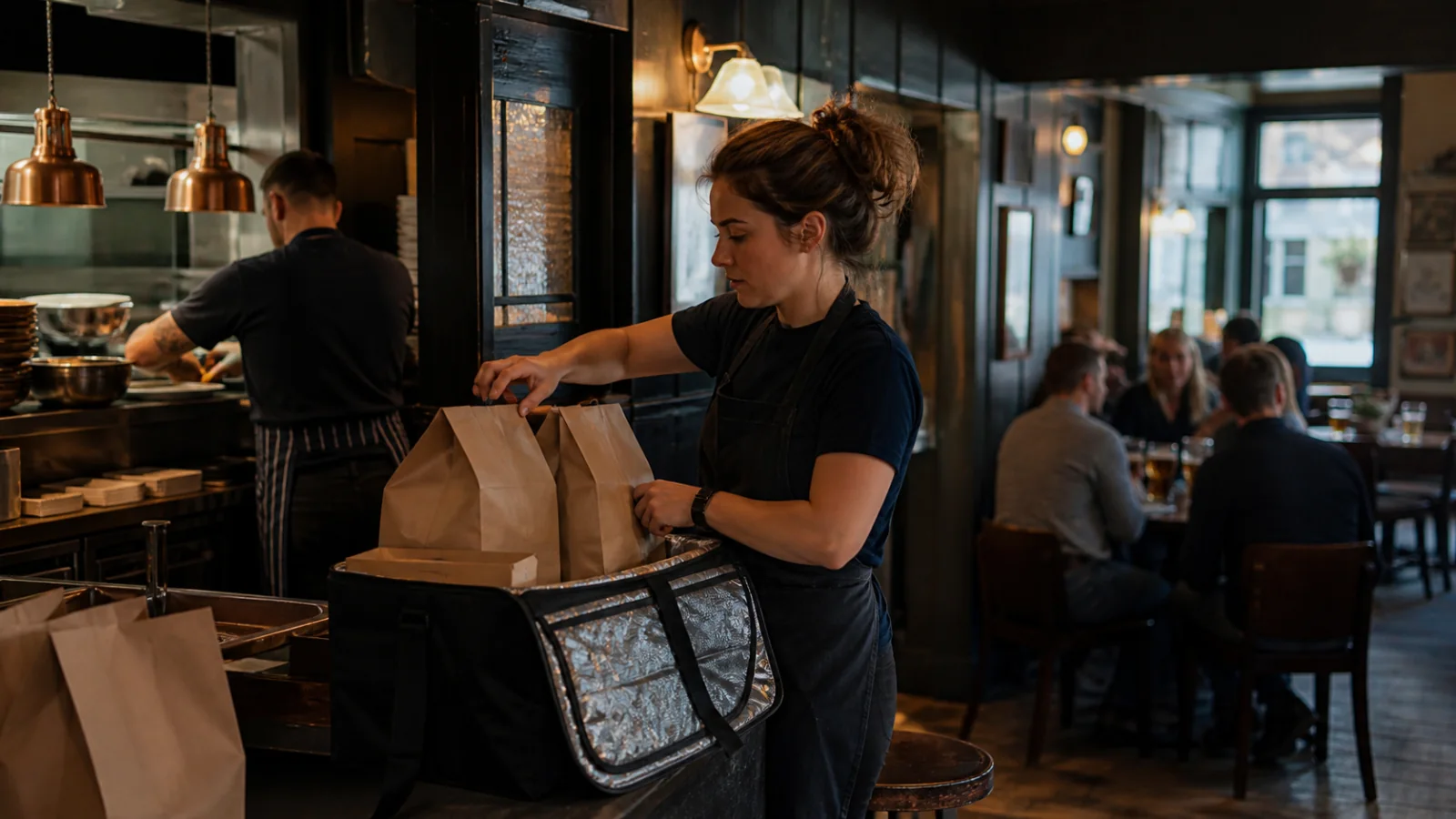
Build a clean, clearly labelled area for packing, checking and handover. It sits out of the chef's path, near the exit customers and riders use, and holds the printer, bag stock, seals, cutlery, sauces, allergen labels and a clipboard.
One named person owns it per shift, written on the rota, not "whoever is free". Their job is a three-point check said out loud on every order: item count, extras and sauces, allergen label. Then seal the bag. Sealed bags cut tampering disputes and give you something to argue with when a platform issues a refund.
Log every missing item on the clipboard. Three weeks of that tells you which dish and which station is costing you money, and one missed sauce genuinely does undo an otherwise good meal.
Step 4: Optimise collection flow
Click and collect should take sixty seconds from door to gone.
Give it a dedicated point away from the bar queue: the end of the counter, a side door, a marked shelf. Sign it from outside and again on the door, because a customer wandering into a busy bar holding their phone is a customer you have already annoyed. Give riders somewhere to wait out of the way, and put those access instructions into your platform listing.
Text customers when the order is genuinely ready rather than giving a fixed time. Then hand over in under a minute: name, order number, sealed bag, thank them.
Taking collection orders through your own website rather than a platform keeps the commission out of it entirely. On the numbers in the next section it is worth more per order than anything else here, so put the direct ordering link on your Google Business Profile, your socials and every bag.
Step 5: Track profit per channel
This is where most pubs discover what they have actually built. Here is a worked example using a £30 hot food order, a 30% food cost, £1.20 of packaging and the commission rates stated. Your own numbers will differ, so run it with them.
Hot takeaway food is standard-rated for VAT, so £30 through the till is £25 net before you start.
| Channel | The sums on a £30 hot order | Left before labour |
|---|---|---|
| Dine-in | £25 net, less £7.50 food | £17.50 |
| Own site, click and collect | £25 net, less £7.50 food, £1.20 packaging, £0.50 card fee | £15.80 |
| Platform, collection at 13% | £25 net, less £7.50 food, £1.20 packaging, £3.90 commission | £12.40 |
| Platform, their rider at 28% | £25 net, less £7.50 food, £1.20 packaging, £8.40 commission | £7.90 |
Two things follow. First, delivery only works if it is genuinely incremental: if a platform order replaces a dine-in cover, you have exchanged £17.50 of contribution for £7.90 and added work to do it. Watch dine-in covers on the nights delivery grows, because cannibalisation is invisible in a revenue total and obvious in a margin total.
Second, run the table on your own VAT position rather than borrowing this one. If you are VAT registered, you hand over the 20% on the sale but you reclaim the VAT charged on platform commission, so the headline commission rate is the real bite. If you are below the registration threshold, the table looks different in both directions: you do not account for output VAT at all, so the whole £30 stays with you rather than £25, but you also cannot reclaim the VAT on commission, so commission costs you a fifth more than the headline rate suggests.
Pull channel-level numbers weekly from the reports your EPOS already produces and set a floor: a minimum cash margin per delivery item after commission and packaging. Anything below it gets repriced or removed. Plenty of operators price the delivery menu above the dine-in menu to absorb commission, which is sound, but read your platform contract first because some include price parity terms.
Step 6: Cross-pollinate marketing
Every platform order is a chance to move somebody onto a channel you own.
Put a card in every bag. Not a discount, because discounts train people to wait for the next one. Put an invitation on it: "Show this card for a table by the fire on any Thursday", plus your own ordering address for next time. You are buying the second visit, not the second order.
Ask for reviews in the right places: platform reviews protect your delivery ranking, Google reviews protect the pub. And where customers order through your own site, capture the email address with proper consent so you can reach them without paying a middleman.
The rules you cannot skip
- Allergens. Distance selling rules require allergen information at two points: before the order is placed, in writing on your website or menu, and again at delivery, on a label or an enclosed menu. The FSA advises keeping it no more than one click from the online menu. Our guide to food allergies, labelling and data compliance covers how to structure it.
- Temperature. Keep hot food above 63°C (UK law). Use insulated bags and keep routes short. In England, Wales and Northern Ireland, not Scotland, the law lets food stay below 63°C once, for less than two hours. After that, the FSA advises cooling it as quickly as possible to 8°C or below, or throwing it away.
- VAT. Hot takeaway is standard-rated at 20%, while genuinely cold takeaway food is usually zero-rated with exceptions. That changes the real margin per dish, so cost the menu on net prices; our pub VAT and accounting guide explains the split.
- Insurance. Staff delivering in their own cars need hire-and-reward cover. A standard social, domestic and commuting policy does not cover paid deliveries, and the driver is uninsured the moment they leave the car park.
- Your hygiene rating. It is displayed on the platforms, next to your name.
Common mistakes
- Running the full dine-in menu on delivery.
- Accepting unlimited orders at peak and wrecking the room that pays the rent.
- Letting riders crowd the bar instead of giving them a waiting spot.
- Judging the channel on revenue rather than margin per order.
- Chasing platform discounts to climb the rankings, then wondering where the profit went.
Quick checklist
- Channel choice made, contracts read, commission rates known.
- Delivery menu shortened, travel-tested and costed on net prices.
- Hourly order caps set by daypart in the platform settings.
- Dispatch station built, one named owner per shift.
- Collection point signed inside and out.
- Allergen information live at both order and handover.
- Profit per channel reviewed weekly against a margin floor.
- Dine-in invitation and direct ordering link in every bag.
Mini FAQ
Should I offer discounts on delivery? Not unless you can protect margin through pricing or bundling. Platform discounts rarely build loyalty, because the loyalty attaches to the app rather than to your pub.
How do I handle slow nights? Lift the cap on quiet days, keep the shorter menu and hold the margin rules. Quiet-night delivery is genuinely incremental revenue, which is exactly when the channel earns its keep.
questions people ask.
Should my pub delivery menu be the same as the dine-in menu?
How do I stop delivery orders disrupting dine-in service?
Is delivery worth it for pubs after platform fees?
Do I have to show allergen information on delivery orders?
Is VAT different on pub delivery and takeaway food?
keep reading.
- OperationsAI for Pubs: What Is New, What Works and Where to StartAI for pubs, from a working licensee: what has changed, the jobs it does well, the shortcuts worth knowing and the house rules that keep you out of trouble.24 min read
- OperationsWet-Led vs Food-Led Pubs: Understanding Your Revenue ModelWhat wet-led and food-led actually mean, the economics of each model, and how to work out which approach is right for your pub.15 min read
- OperationsFood Allergies and GDPR: The Compliance Nightmares That Could Close You DownNavigate the compliance minefield without hiring expensive consultants. Simple systems that keep you legal and let you focus on running your pub.10 min read
not sure this is your actual problem?
That's the more common situation, and it's what the first conversation is for. An hour, free, going through what's happening in your business before anybody suggests a fix.