
Live Music Events for Pubs: The Complete Guide to Booking, Hosting & Profiting
From open mic nights to booked bands: how to work out whether live music fits your pub, what to pay, which licences apply, and how to tell if the night made money.
9 January 2025 · 10 min read · Peter Pitcher
Quick answer
Check first that your locals want live music, your room can handle the sound, and your team can cope with the extra flow. Then start with open mic nights, which carry the lowest risk, and only book paid acts once demand is proven. Control volume, track spend per head, and add a ticket or deposit for premium tables.
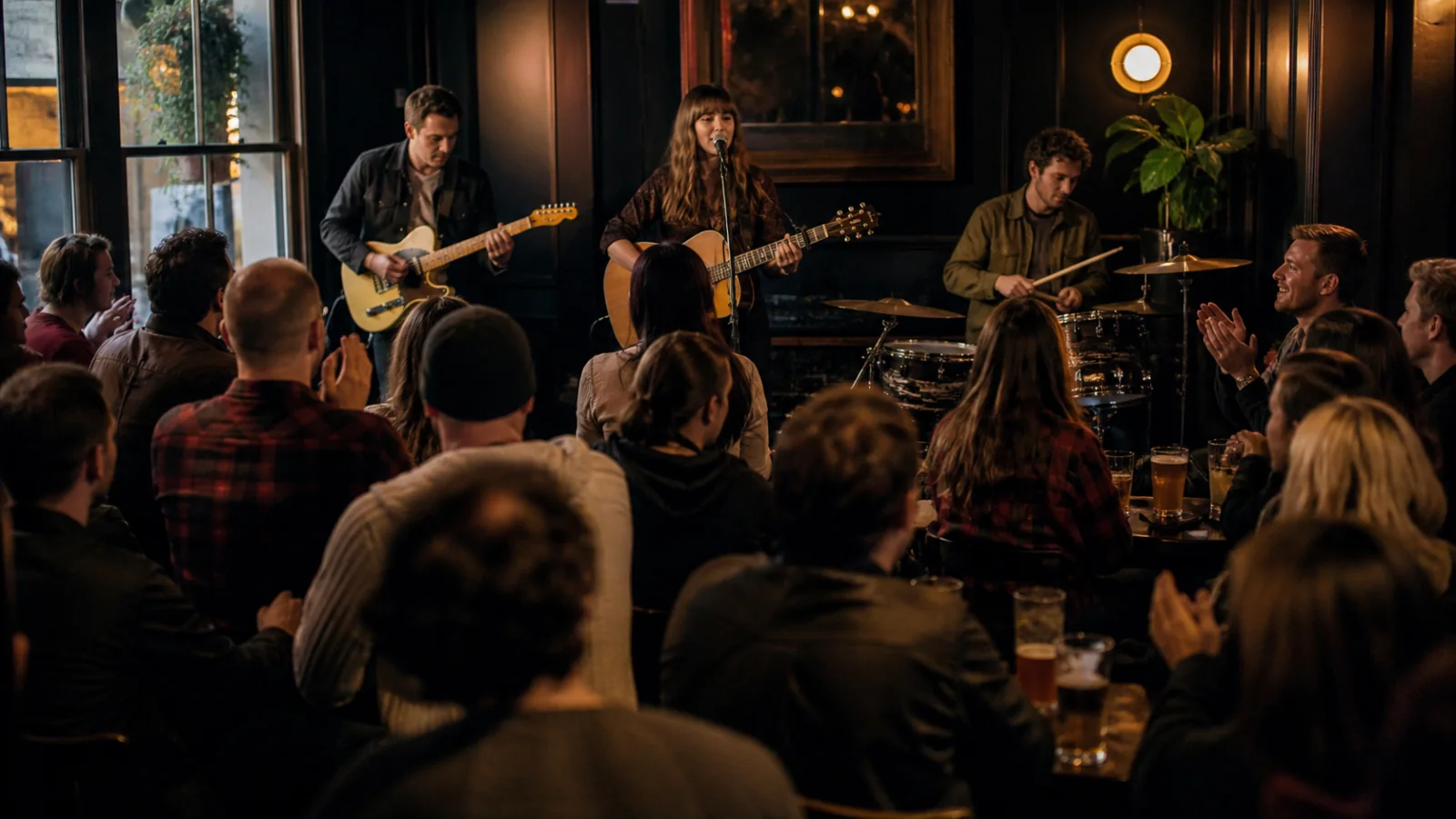
Live music can turn a dead Friday into the night people plan their week around. It can also empty your quieter rooms, upset the neighbours and swallow £500 in an evening with nothing to show.
The difference is almost never the act. It is whether you built the night as a business decision or as a hopeful punt.
What follows is the progression I would use in any pub, and the same one behind any successful pub event: start small, prove demand, then scale. Each step happens only once the one before it has earned it.
Step 1: Decide if live music fits your pub
Three checks, and you can do all of them this week.
Do your locals want it? Ask twenty regulars over a few shifts, and ask properly. Not "would you like live music?" (everyone says yes) but "which night would you actually come out for, and what sort of thing?"
Can the room take it? Find the spot before you find the act. It needs a double socket, a clear route out for staff, and it must not block a fire exit or the toilet corridor. Stand in the far corner, play music from a speaker at gig volume, and try to hold a conversation. If you cannot, that corner is where you will lose your quiet drinkers.
Can the team cope? A music night is compressed trade. Everyone arrives inside forty minutes and everyone wants a drink at once. If one person is on the bar, live music will make your service worse, not better.
The fourth check is the one people forget: the neighbours. Noise from licensed premises can be a statutory nuisance under the Environmental Protection Act 1990, and repeated complaints can trigger a review of your premises licence. Knock on the three nearest doors first, give them the finish time and your mobile number. A neighbour who can ring you rings you. A neighbour who cannot rings the council.
The mistake to avoid: booking a five-piece with a drum kit into a 40-cover dining room because they happened to be free. Match the act to the room, not the diary.
Sort the licences before you book anyone
Two completely separate things get muddled here.
Permission to host the entertainment. Under the Live Music Act 2012, amended in April 2015, live and recorded music stops counting as regulated entertainment if you hold a premises licence authorising on-sales, the premises are open for that, the music happens between 8am and 11pm, and the audience is no more than 500. Staff and performers do not count towards that 500. That covers the overwhelming majority of pub gigs, so most licensees need do nothing for a Friday acoustic set finishing at half ten.
Two caveats. Anything past 11pm falls outside the exemption and needs authorisation, either on your licence or through a Temporary Event Notice. And conditions can be reimposed after a licence review, so read your actual licence rather than assuming what it says.
Permission to use the music itself. That is TheMusicLicence, run jointly by PPL and PRS for Music since 2018. It covers recorded music and live performances of other people's songs, whether that music comes from a radio, a playlist or a bloke with a guitar. Our breakdown of PRS and PPL music licensing for pubs explains the tariffs. Display the licence behind the bar.
Two bits of admin worth ten minutes: ask every act for their public liability certificate and PAT test confirmation, and check your own policy mentions live entertainment.
Step 2: Start with open mic or acoustic sets
Open mic is the cheapest market research in hospitality. For the price of one host you find out whether your town has musicians, whether they bring people, and whether your room works. It builds a music reputation the way a karaoke night builds a singalong crowd, by letting your customers supply the entertainment.
The format that works:
- Sign-up sheet opens at 7pm, first act at 8pm, hard finish at 10:30pm.
- Three songs or fifteen minutes per slot, whichever comes first. No exceptions.
- The host plays the first slot to warm the room and the last to close it.
- The host owns the PA, the running order and the volume.
Pay one experienced host rather than paying performers. A host with their own small PA will take a regular fortnightly slot for meaningfully less than a booked solo act, because a repeat booking is worth more to them than a one-off.
Why it works, as a hypothetical example: twelve performers who each bring two people is thirty-six extra bodies, and performers drink while they wait for their turn. You are not paying for an audience, you are paying for a mechanism that produces one.
The mistake to avoid: a soft host. One man doing nine songs at 9pm kills the night and every performer after him goes home.
Step 3: Move to paid acts
Once you have three or four open mics behind you and you know which night pulls, start booking.
| Act type | Typical UK pub fee | What you actually get | Best used for |
|---|---|---|---|
| Open mic host | Cheapest by far | A host, a PA and a room of performers' friends | Building a music habit from nothing |
| Solo acoustic | £150 to £300 | One voice, easy to place and control | Sunday afternoons, quiet midweek |
| Acoustic duo | £200 to £400 | More texture, still conversational | Friday early evening |
| Covers or function band | £400 to £800 | Volume, dancing, a proper event feel | Saturdays, bank holidays, big fixtures |
| Tribute or ticketed act | Higher, usually ticketed | A reason for people to travel to you | Once a quarter, promoted hard |
The Musicians' Union publishes a recommended national rate card, and its 2026 minimum for a pub or club engagement of up to three hours sits a little over £160 per musician. Plenty of acts work below it, but when you are quoted £700 for a four-piece, that rate card is the reason.
Do the break-even sum before you say yes. Say you book a four-piece for £450 and put one extra person on for five hours at an all-in cost of £14 an hour. That is £520 of cost. Now work the gross profit on your net sales, not on your till takings, because a fifth of every pound over the bar is VAT that was never yours. If your wet gross margin runs at 60%, which sits inside the 55% to 65% most pubs work to, you need £867 of net sales to produce £520 of gross profit, and £867 net is roughly £1,040 through the till. At £12 spend a head, that is about 87 extra people through the door. Write "87" on the booking sheet. It changes how hard you promote.
Put the deal on one side of A4. Date, load-in, sound check, two set times (9:00 and 10:15 works well), fee, how and when you pay, agreed volume limit, what you provide (parking, meals, drinks tab and its cap), and cancellation notice both ways. Most pub acts invoice as self-employed, but employment status is decided by the facts of the engagement rather than by what either side writes down, so if you are booking the same act every week on your terms, take advice rather than assuming. Book the first date as a trial and say so.
Step 4: Control sound and flow
Bad sound is the fastest way to make live music feel cheap.
Point the PA into the room, not into a wall or a low beam, and get the speakers off the floor. Agree one volume rule at sound check and hold it all night: if the bar team cannot take an order without shouting, it is too loud. A free sound level app gives you a reference reading at sound check. Note it, hold it, and re-check twenty minutes into the first set, because a full room sounds nothing like an empty one and the act will creep the volume up.
Flow matters as much as sound. Keep a clear path from door to bar to toilets, move two tables out rather than have staff squeeze past a guitarist, put a card machine on the floor, and pre-pour the obvious rounds before the interval, because that is when a large chunk of your takings arrives in eight minutes. Then give your quiet drinkers a snug with the door shut, which keeps the regulars who hate music spending.
Step 5: Build a profit plan
Three levers: more people, longer stays, higher spend per head. Pull all three.
Take bookings, and give people a reason to make one. Reserve the best tables and hold them with a £5 per head deposit that comes off the bar bill. It costs the customer nothing and turns a maybe into a commitment. At The Anchor, our own venue, we increased table bookings by 403%, largely by making booking easy and clearly worth doing rather than leaving people to chance it. If your regulars have stopped booking at all, we have written separately about why nobody books tables any more.
Feed them. A short music-night menu of sharing boards and one-tray dishes lets the kitchen cope with a compressed rush. Run it to 9pm, then keep bar snacks going so nobody leaves to find chips.
Bundle. A bottle of house wine plus a board at a set price lifts table spend and speeds up service, because it is one decision instead of four.
Measure it properly. Total takings, minus the fee and the extra staff hours, against the average for that weekday over the previous four weeks. That is your contribution. Two negative nights in a row means the act, the night or the price is wrong. Change one variable, not all three.
Step 6: Promote the gig so people turn up
An unpromoted band is just an expensive noise.
Run a three-part cadence: announce three weeks out, remind one week out, post on the day. Ask every act for a twenty-second video clip and their social handles when you confirm the booking, and put that in the contract. A clip of the act playing outperforms a poster every time, and when they share it you reach people who have never heard of your pub.
Add the gig to your Google Business Profile as a post so it surfaces when someone searches for pubs near you on the day; our Google Business Profile guide for pubs covers the setup.
Then the bit almost everyone forgets: announce the next date from the stage before the last song, chalk it up before you lock the doors, and take email addresses while people are still enjoying themselves.
Common mistakes
- Booking an expensive act before demand is proven. Run open mic first.
- Ignoring sound quality. Bad sound makes a good band sound like a bad one.
- No agreed volume limit, so nobody can enforce one at half nine.
- Forgetting the neighbours. One unhappy household can cost you licence conditions.
- No break-even number. Without it you cannot tell whether the night worked.
Quick checklist
- Night chosen, room spot identified, neighbours told.
- Premises licence checked; TheMusicLicence in place and displayed.
- Open mic run at least twice before any paid booking.
- Contract on one page: fee, set times, volume limit, cancellation.
- Break-even number written on the booking sheet.
- Deposit-backed bookings, music-night menu and promotion plan live.
questions people ask.
Do I need music licences for live music in my pub?
How do I stop regulars complaining about live music?
How much should I pay a live music act?
Do I need to add live music to my premises licence?
How do I know whether a live music night actually made money?
keep reading.
- EventsAutumn Pub Event Ideas: The Playbook for Sept–NovThe autumn pub event ideas that actually fill tables: cask, low and no, wine, Halloween, rugby and gifting. The September-to-November moments and how to run them.5 min read
- EventsAutumn Internationals 2026: Fill Your Pub for the RugbyYour operator's guide to filling the pub for the autumn internationals in November 2026. Where to watch rugby, table bookings, match platters and a screen checklist.9 min read
- EventsBlack Friday Ideas for Pubs: Turn It Into BookingsBlack Friday ideas for pubs that build your December instead of cutting prices: turn the weekend into party deposits, pre-orders, gift-card sales and a January bounce-back. A plan to bank bookings and revenue, with no discount war.10 min read
not sure this is your actual problem?
That's the more common situation, and it's what the first conversation is for. An hour, free, going through what's happening in your business before anybody suggests a fix.